
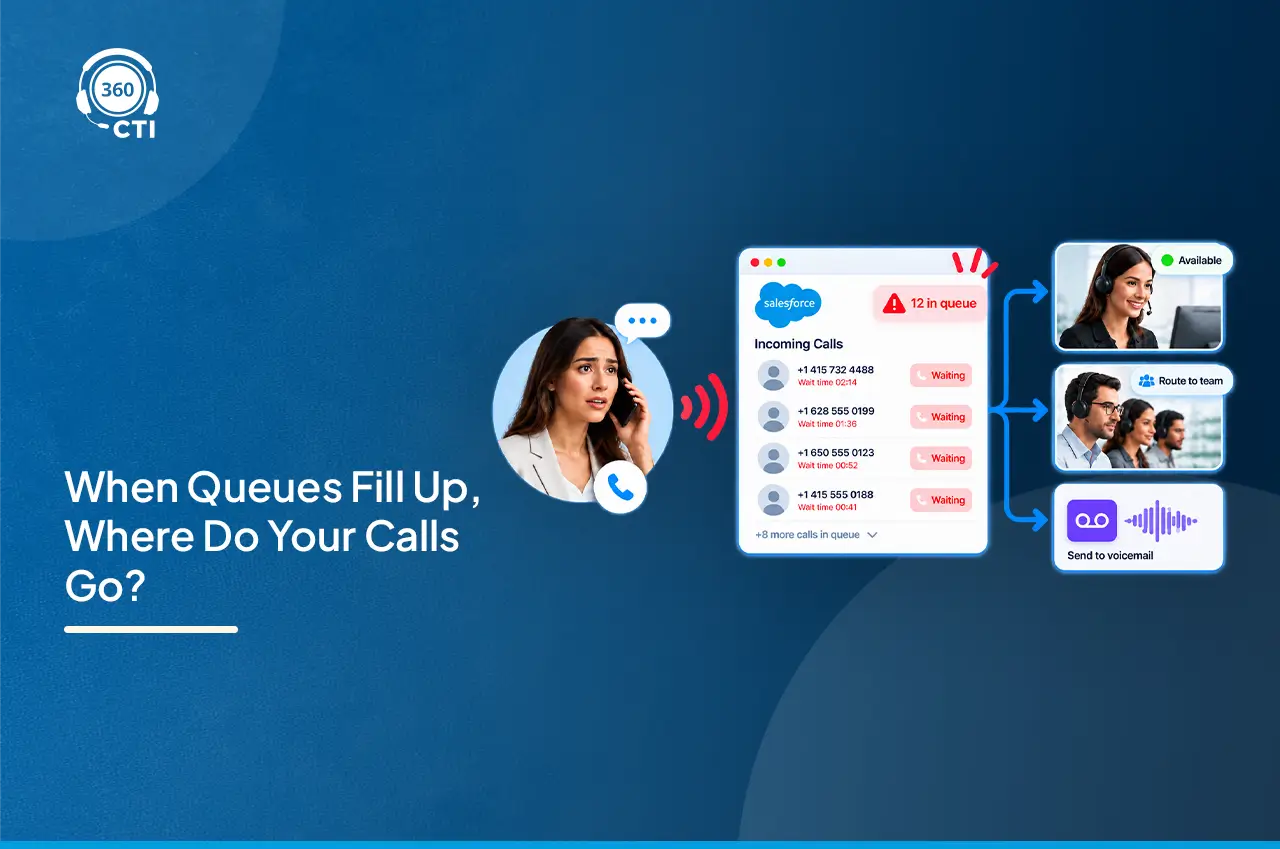
Every contact center hits a wall during peak hours. Phones ring. Queues stack up. Agents are already on calls. And somewhere in that pile of missed calls is a prospect who won’t call back. Or a customer who will.
Contact center CTI is what determines whether those calls disappear or get caught. Not theoretically. In the actual routing logic, queue fallback configuration, and IVR structure your team builds before volume spikes.
This blog breaks down exactly how Salesforce contact centers use CTI to handle overflow: the four routing options that matter, what to build before peak season, and the after-hours gap most teams leave open longer than they realize.
Want to see how call routing distribution works inside Salesforce?

Why Call Overflow Is a Conversion Problem
Here’s what most operations leaders get wrong about overflow: they treat it as a staffing issue. More agents, problem solved. But the routing layer fails first. No amount of headcount fixes a misconfigured queue.
When a call hits your Salesforce contact center and no agent is available, what happens next is entirely determined by what your CTI configuration says to do. No configuration, or a bad one, means the caller gets a busy signal, a hold loop that goes nowhere, or drops entirely.
The business math on this is brutal. A missed inbound call from a qualified lead costs more than any per-seat CTI subscription. And for support teams, a dropped call from a frustrated customer is the kind of event that ends up in a churn report three months later.
That’s why overflow handling is a revenue problem disguised as an IT configuration task.
How Salesforce CTI Handles Inbound Overflow
When your queue hits capacity, a well-configured CTI system doesn’t just put callers on hold and hope. It runs through a defined fallback sequence.
With 360 CTI, there are four routing fallback options Salesforce teams actually use:
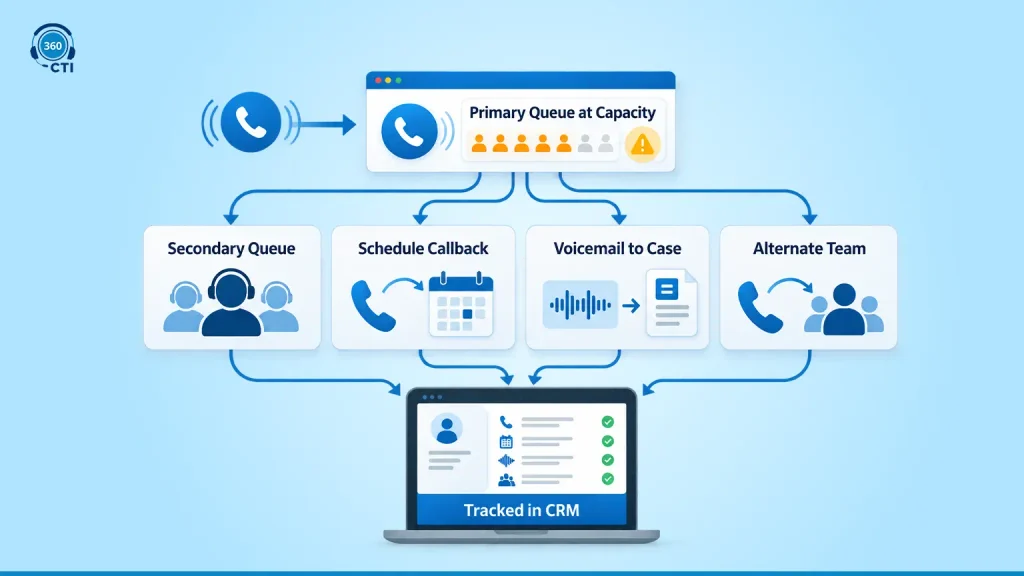
1. Overflow to a secondary queue When the primary queue fills past a set threshold (say, five callers waiting or hold time exceeding three minutes) calls route automatically to a secondary queue. That queue might serve a different agent group, a different skill tier, or a backup team entirely. The caller doesn’t know. They just get answered faster.
2. Callback scheduling Instead of waiting on hold, the caller gets an option leave a number, get a callback when an agent is free. Most callers take it. Hold times drop. Abandonment rates drop. The callback request logs directly to the Salesforce record, so when the agent calls back, the context is already there.
3. Voicemail with automatic case creation The caller leaves a message. 360 CTI captures the recording, transcribes it, and creates a Salesforce case automatically, attached to the right account or contact, with the recording accessible from the record. Nothing falls through manually. The follow-up is already in the queue.
4. Redirect to an alternate number or team For teams with regional offices or outsourced overflow partners, calls can be redirected to an external number after a defined wait threshold. The Salesforce record still logs the attempt, so the internal team knows the call happened even if it was handled externally.
None of this runs automatically on day one. It requires deliberate configuration. Which is exactly why most teams skip it until they’re already in crisis mode.
IVR Configuration for Overflow: What to Build Before Peak Season Hits
Most contact centers build their IVR for normal conditions. That’s the mistake.
A Multilevel IVR configured only for average call volume will collapse the moment you run a promotion, hit a seasonal spike, or go through a product issue that triples inbound volume in 48 hours.
So what does overflow-ready IVR configuration actually look like? A few things that don’t get discussed enough:
Build time-of-day logic into your routing rules before you need it. Not after the first spike. If your contact center gets 60% of its calls between 10am and 2pm, your IVR should route differently during those windows: shorter menu trees, faster queue entry, priority routing for high-value accounts.
Set queue depth thresholds that trigger before agents feel the pain. Most teams configure thresholds reactively. By the time the threshold fires, the queue is already five deep and agents are stressed. Set your fallback trigger at 60% of what you think it should be.
Test your IVR fallbacks in staging before peak periods. This is obvious and almost never done. Run a simulated spike in a sandbox environment, confirm that calls actually hit the secondary queue, confirm that voicemail-to-case creation fires, confirm that callbacks log correctly to Salesforce records.
The 360 CTI IVR builder handles this configuration in-platform. No Amazon Connect dependency, no external IVR system to maintain separately. Routing rules sit inside Salesforce, which means your admin team can adjust them without a developer on call.
How Real-Time Queue Visibility Helps Managers Intervene
Knowing you have a problem and knowing you have a problem right now are completely different things.
Real-time queue visibility in Salesforce CTI gives managers a live view of: how many calls are waiting, which agents are available, how long the longest caller has been holding, and whether any queue is approaching its overflow threshold.
That last one matters most. If a manager can see that Queue A is at 70% capacity at 9:15am on a Monday, they can manually redirect agents from lower-priority queues before Queue A tips into overflow mode. That’s the intervention window. Miss it, and the overflow fires automatically. That’s fine if it’s configured, but some calls still have a worse experience than they would have had with a human decision made two minutes earlier.
For teams running intelligent call routing for contact centers, the AI layer adds a second dimension: it doesn’t just route based on availability, it routes based on which agent is most likely to resolve the call on the first attempt. That reduces transfer rates. And transfer rates are where overflow problems compound. Every transfer is a call that effectively becomes two.
In one healthcare contact center context, teams using smarter routing configurations reported 61% fewer unnecessary transfers. Fewer transfers means shorter average handle time, which means the queue clears faster under load.
After-Hours Call Handling in Salesforce
After-hours configuration is where even well-run contact centers leave money on the table.
The default setup most teams run: a recorded message that says “we’re closed, call back during business hours.” That’s it. No voicemail. No case creation. No record of who called, when, or what they wanted.
But look: someone calling your contact center at 11pm isn’t calling for fun. They have a problem. And they’ll solve it with whoever calls them back first in the morning.
Here’s what after-hours handling should actually include:
First, an IVR flow that’s distinct from your daytime flow. Don’t just kill the queue routing and play an outgoing message. Build a separate flow that acknowledges the after-hours situation and gives callers a real option: voicemail with a specific callback commitment, or an emergency escalation path for urgent cases.
Second, automatic case or lead creation from every voicemail. Every after-hours call that leaves a message should create a Salesforce record before your team gets in the next morning. That way, the first thing agents see is an already-queued list of after-hours contacts to follow up on. Not a pile of voicemails they have to manually log.
Third, routing based on urgency. For contact centers managing support tiers or SLA-bound accounts, after-hours calls from high-value customers can still route to an on-call team or an emergency line. That configuration is available inside 360 CTI without custom development.
Most teams get this wrong because after-hours feels like a secondary configuration. It isn’t. It’s the window where your competitors answer and you don’t.