
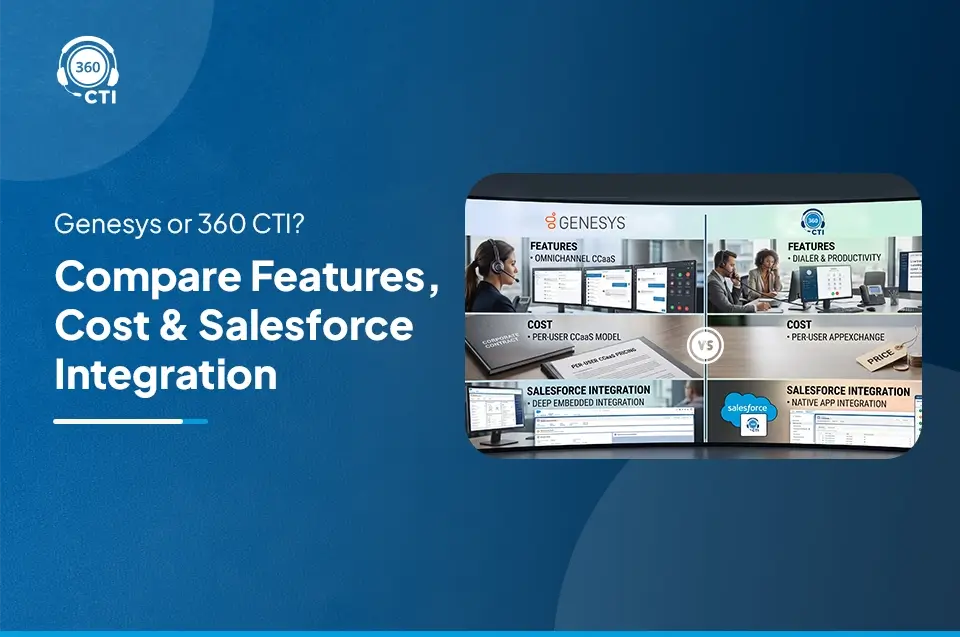
Somewhere in most Genesys evaluations, a Salesforce admin asks a quiet question nobody wants to answer out loud: why are we building a second platform just to make phone calls work with the CRM we already run everything through? That question is usually the real starting point for this comparison, not the feature list.
Genesys Cloud is a serious contact center platform, built for organizations running voice, chat, email, and social across thousands of agents, with workforce management and AI layered on top. 360 CTI was built for a narrower, more common problem: Salesforce teams who need calling to work inside Salesforce, not alongside it. Neither claim knocks the other product. Most searches for a Genesys salesforce alternative aren’t really a hunt for more features. They’re a search for a platform that fits how the team already works.
Ready to Replace Complex CTI with Native Salesforce Calling?

Who This Comparison Is For
This is written for Salesforce admins, IT decision-makers, and RevOps leaders comparing enterprise CTI options for a Salesforce-first organization. If your team’s system of record is Salesforce and your evaluation keeps circling back to “how much of this lives outside our CRM,” you’re the intended reader.
Genesys makes sense for large, multi-channel operations where the contact center is the center of gravity and Salesforce is one integration among several. 360 CTI, a Salesforce native alternative to Genesys, makes sense when Salesforce is already the center of gravity, and calling needs to fit into that, not compete with it. Worth saying up front: this isn’t really a “better product” argument. It’s a scope-fit argument.
360 CTI vs Genesys at a Glance
Here is how the two platforms stack up on the factors that actually decide a Salesforce-first evaluation: integration depth, rollout speed, admin load, and total cost.
| Feature | 360 CTI | Genesys Cloud CX |
| Salesforce integration method | Native, built inside Salesforce | Managed package plus API connector |
| Implementation timeline | Typically 2 to 4 weeks | Typically 3 to 6 months with an SI |
| Setup complexity | Configured within existing Salesforce admin tools | Separate platform configuration plus Salesforce sync |
| Admin overhead | One system, one permission model | Two systems, two admin skill sets |
| AI features | AI voice agent, transcription, sentiment, coaching, built for CTI use cases | Predictive routing, Agent Copilot, journey orchestration, full WEM suite |
| Compliance recording | Native call recording tied to Salesforce records | Recording plus quality management modules |
| Call routing depth | Skill, team, region, and priority-based routing inside Salesforce | Advanced omnichannel routing across voice, chat, email, social |
| Pricing model | Per-user, Salesforce-native, no telecom line items to reconcile separately | Four-tier per-agent pricing, $75 to $240/user/month, plus usage and AI token costs |
| Mobile support | Native Salesforce mobile calling | Supported through Genesys mobile apps and integrations |
| AppExchange availability | Listed on Salesforce AppExchange | Available via Salesforce connector, not an AppExchange-native app |
Looking for a Salesforce-native alternative to Five9?
The Salesforce Integration Difference
Genesys Cloud’s Salesforce integration runs through a managed package and an API-based connector. It works. Genesys has invested in the connector for years, and it does what it says. But call data originates in Genesys and syncs into Salesforce, not the other way around. Which means admins end up managing two systems: Genesys owns call configuration, routing rules, and voice infrastructure, while Salesforce owns CRM data and holds a synced copy of what happened on the call.
360 CTI skips that step entirely. There’s no second system to sync, because there isn’t a second system. Routing rules, agent availability, call recordings, call logs, and disposition data all live inside Salesforce as native objects. For a team that has spent years customizing Salesforce permission sets, page layouts, and reporting, that matters more than it sounds like on paper. You’re not learning a new admin console. You’re using the one you already know.
To be fair, that separation ist lets Genesys scale to enterprise telephony volumes and multi-CRM environments. But most Salesforce-first teams aren’t running a separate service platform, they’re running Salesforce, and for them, keeping calling native to the CRM removes a maintenance burden Genesys simply wasn’t built to remove.
Implementation Complexity and Timeline
Genesys Cloud implementations for mid-market teams typically run 3 to 6 months when you bring in a systems integrator, and that’s before counting the separate Salesforce connector configuration. Vendor pricing guides put mid-size deployments (300 to 700 agents) in the $3.2 million to $7.5 million annual range once AI and workforce engagement modules are added, which gives you a sense of the implementation scope that number implies.
360 CTI implementations for Salesforce-first teams typically complete in 2 to 4 weeks. That’s not a marketing number, it’s a function of what’s actually being built: there’s no separate telephony platform to stand up, no parallel integration project, no second team learning a new system. Configuration happens inside the Salesforce environment the admin already manages daily.
Three things drive that gap:
- Fewer tools in the stack, because CTI configuration and CRM configuration are the same task
- Fewer teams involved, since one Salesforce admin can typically own the whole rollout
- Fewer dependencies, because there’s no connector version, sync schedule, or API rate limit sitting between the two systems
That’s the practical difference. Not “faster because it’s simpler,” but faster because there’s genuinely less to build.
AI Features: How They Compare
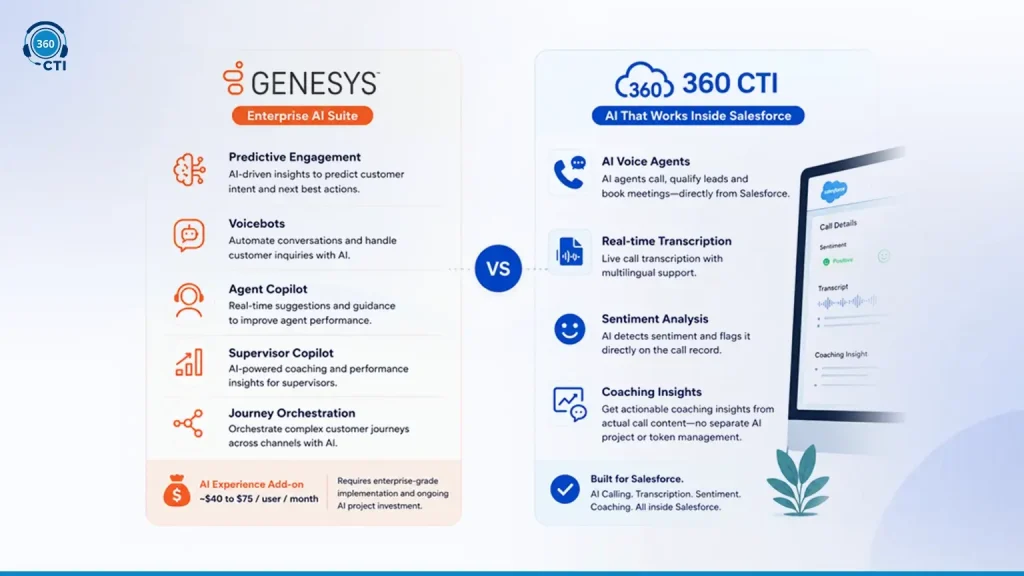
Genesys has a deep AI suite: predictive engagement, voicebots, Agent Copilot, Supervisor Copilot, journey orchestration, all sold through an AI Experience add-on running roughly $40 to $75/user/month on top of base licensing. These are enterprise-grade capabilities that require enterprise-grade implementation to use well. Buying the tokens is the easy part. Building the journeys and training the models is where the real project lives.
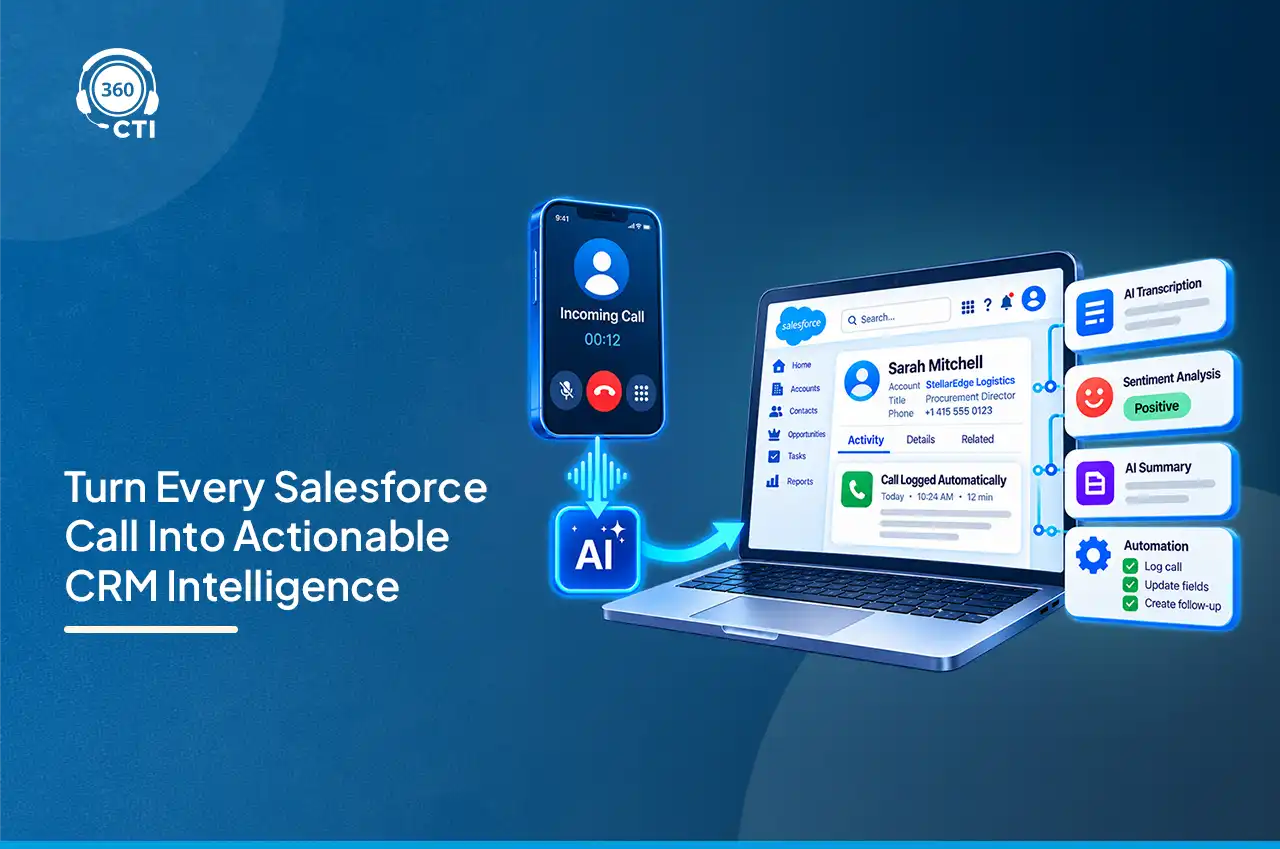
360 CTI’s AI features are narrower by design. AI voice agents that call, qualify, and book meetings from Salesforce. Real-time transcription with multilingual support. Sentiment analysis flagged directly on the call record. Coaching insights generated from actual call content, without a separate AI implementation project or a token budget to manage.
Here’s the honest version: if your team needs the full Genesys AI stack, journey orchestration and all, 360 CTI isn’t a substitute for that. But if what you actually need is AI calling, transcription, and coaching that works inside Salesforce without a six-figure AI rollout attached to it, that’s a different requirement, and it’s the one 360 CTI is built to answer.
Total Cost of Ownership
Genesys Cloud CX pricing runs across four tiers: CX 1 starts around $75/user/month for voice-only, CX 2 sits near $110 to $115 for omnichannel, CX 3 lands around $140 to $155 with workforce engagement included, and CX 4 tops out at $240/user/month for the full AI-driven suite. Implementation adds $150,000 for a simple voice deployment to well over $1 million for complex migrations, and the total climbs fast beyond a small pilot.
This is usually where the cost argument for a genesys salesforce alternative gets concrete. 360 CTI’s total cost sits meaningfully lower, and not because of a discount. It’s structural. There’s no separate platform implementation to fund, no parallel admin headcount to manage a second system, and no connector to maintain and re-certify every time either platform updates. The cost categories that inflate a Genesys deployment (implementation services, connector maintenance, dual-system admin time) mostly don’t exist in a native Salesforce CTI model.
Genesys’s usage-based telephony pricing adds another layer worth flagging. Outbound calling typically runs $0.012 to $0.03 per minute depending on volume and negotiated rates, which for a team making tens of thousands of minutes a month becomes a real budget line, not a rounding error.
Which Teams Should Choose Genesys
Genesys is the right call for a specific set of organizations, and it’s worth naming them honestly:
- Large enterprise contact centers running 500 or more agents across multiple channels and regions
- Organizations that need a platform-agnostic call system independent of any single CRM
- Teams with dedicated contact center IT staff who can manage a separate platform at scale, on an ongoing basis
- Companies that need Genesys’s full workforce management, quality management, and AI suite as one integrated package, and have the budget and implementation runway to build it properly
If that’s your organization, Genesys earns its complexity. For nearly every other Salesforce-first team, that complexity is exactly what 360 CTI was built to remove.
Which Teams Should Choose 360 CTI
This section is where most buyers actually land: 360 CTI fits a different, more common profile. Mid-market teams running Salesforce Lightning as their operational core, where every interaction needs to land in Salesforce without a sync delay. Sales and service teams that tried an enterprise CTI platform, found the sync unreliable or the admin burden too high, and want something that just lives where the CRM already lives. Admins who want to manage calling permissions, routing, and reporting through the tools they already use. And teams stepping back from Genesys because the complexity-to-value ratio stopped making sense at their scale.
That last group is bigger than people admit publicly. Not every team that evaluates Genesys ends up needing everything Genesys does.
Conclusion
Genesys and 360 CTI aren’t really competing for the same buyer, even though they show up in the same evaluation spreadsheets. One is built to be the contact center. The other is built to be part of Salesforce, and for the vast majority of Salesforce-first teams reading this, that’s the platform that gets calling live faster, keeps it cheaper to run, and keeps every conversation exactly where the rest of the business already looks for it.